

03.08.2026 · 5 min



Open, fixed or fee-paying: the offer type shapes your competition.
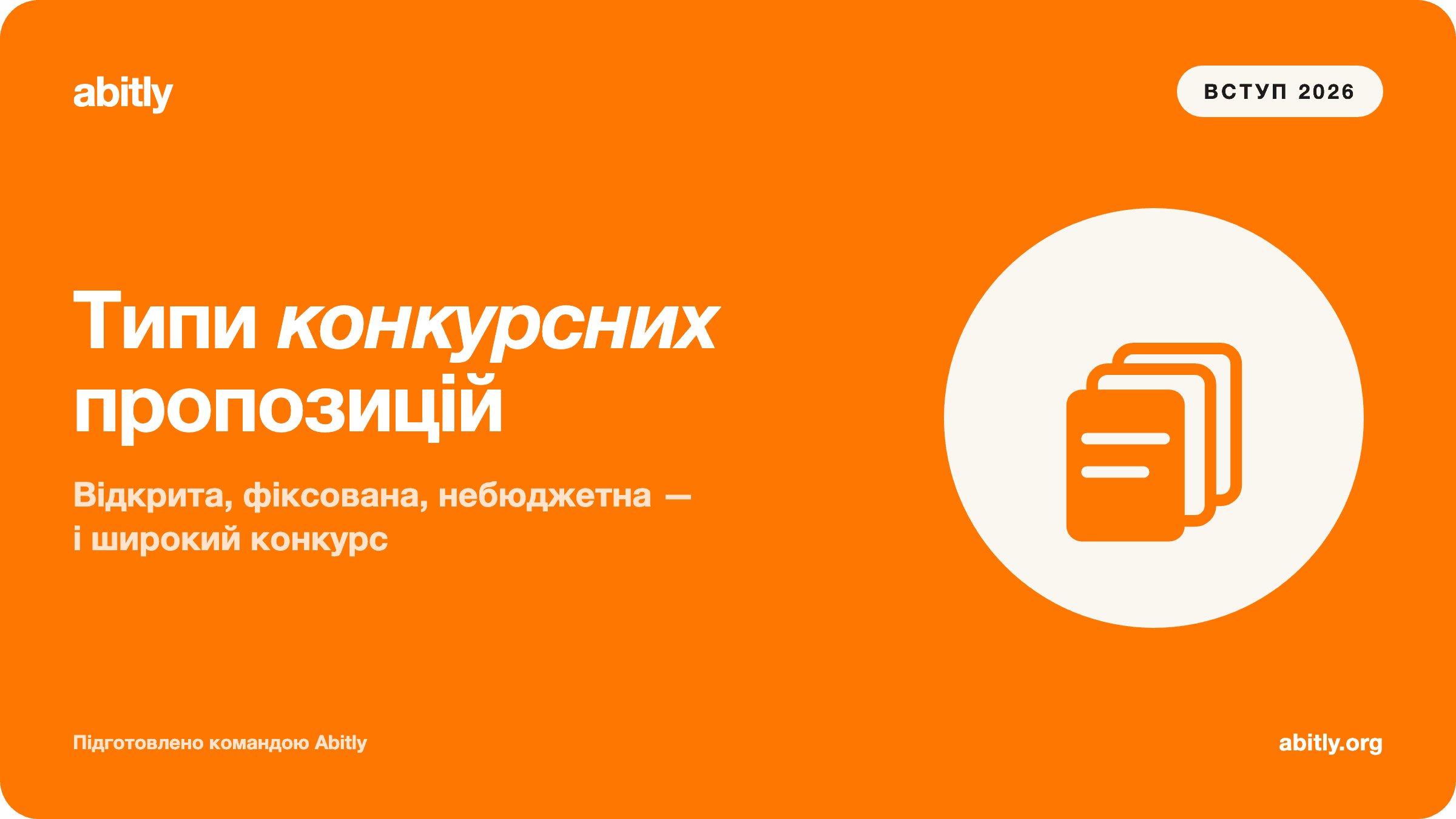
In the catalogue, next to every program, you will see the type of competitive offer — open, fixed or fee-paying-only. The type determines how the state-funded places are distributed and who you compete against for them.
A competitive offer is a specific program at a specific institution that you apply to. There are three types:
Put simply: on an open offer your state-funded place is decided in a shared pot with the whole country; on a fixed one, within a single institution; a fee-paying-only offer is exactly that.
Everything below is based on the official 2026 Admission Procedure (Ministry of Education and Science Order No. 373).
Wide competition is a shared “pot” of state-funded places (the super-volume of state-funded places) for one specialty and mode of study, made up of all the open competitive offers from all institutions together.
Why it exists:

Each open offer belongs to exactly one wide competition. That is how the targeted placement algorithm works: it compares all applicants at once and recommends each of them for the highest priority their score qualifies them for.
The type of offer does not change the main rule: order your applications by what you genuinely want. It only explains how your chances will be counted.
Are applications considered simultaneously?
Yes. Targeted placement compares every applicant in the wide competition at the same time, by competitive score and priority — not by who applied first. When you submit has no effect on the outcome.
Open or fixed — which is better for me?
It is not “better or worse”, just a different way of distributing places. On an open offer the competition is wider (the whole country); on a fixed one it is within the institution. Look at the cut-off scores of previous years for the particular offer.
What is the super-volume?
It is the total number of state-funded places for a specialty across all institutions in the wide competition. That is the pot targeted placement distributes.
Sources. The 2026 Admission Procedure (Ministry of Education and Science Order No. 373). The official Ministry Applicant Guide 2026 and the EDBO account take precedence over any guide.
Disclaimer. This material is a guide as of June 2026 and does not replace the official sources. Make your final decisions on the basis of the Admission Procedure, the Ministry’s Applicant Guide and a conversation with the admissions committee.
The state pays part of your tuition: who gets a grant and how much.
23.07.2026 · 8 min
Where to find the 2026 ranking lists and how to read your position.
23.07.2026 · 8 min
The hackathon from inside: the Blender rig and the night between days.
22.07.2026 · 8 min