

03.08.2026 · 5 min



Which NMT elective subject gives you the highest competitive score.
The NMT 2026 consists of 4 subjects: 3 compulsory + 1 of your choice.
An elective subject is not just "one more exam". It feeds directly into your competitive score through the weighting coefficient K4. For some specialties it carries the maximum weight (K4 = 0.5), for others the minimum (K4 = 0.2).
And here is the key part: even if you pick a subject that carries the minimum coefficient for your specialty, it your competitive score. Because of a subtle detail in the denominator of the formula.
You choose the subject when you register for the NMT. It cannot be changed after registration closes — get it right the first time!
Key dates for NMT 2026 registration and testing:

There is an important detail in the competitive-score formula. The denominator contains not simply K4, but:
(K4max + K4) / 2
Where:
What does this mean in practice?
If you chose the core subject → K4 = K4max → no penalty.
If you chose a non-core subject → K4 < K4max → the denominator grows → your competitive score drops.
Specialty: Journalism (C7). All NMT scores = 170.
The difference: ~16 points with identical results! 16 points is the gap between a state-funded place and a tuition-paying one across dozens of specialties.
Important: even if you score lower on the core subject than you would on a non-core one, the formula can still work in your favour. What matters is not the raw score for the subject but its contribution to the final competitive score, and it is the coefficients that decide that contribution.
For a detailed breakdown of the competitive-score formula, every element and worked examples, see the calculator page:
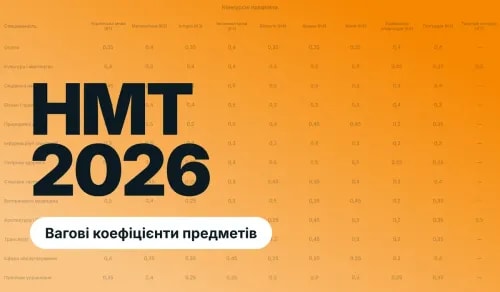
This is the main table from Annex 9 to the 2026 Admission Procedure. It shows which subject is the "core" one — carrying the highest K4 — for each field.
Medical: Medicine (I2), Dentistry (I1), Pediatrics (I3), Medical Psychology (I4), Nursing (I5), Pharmacy (I8), Therapy and Rehabilitation (I7), Public Health (I9), other medical fields (I6, I10, I11)
Natural sciences: Biology and Biochemistry (E1), Ecology (E2)
Agricultural: Agronomy (H1), Animal Husbandry (H2), Landscape Gardening (H3), Forestry (H4), Aquatic Bioresources (H5), Veterinary Medicine (H6), Agricultural Engineering (H7)
Engineering: Biotechnology and Bioengineering (G21), Biomedical Engineering (G22), Environmental Protection Technologies (G2), Wood Processing Technologies (G14)
Education: Secondary Education — Biology (A4.05), Special Education (A6)
For all other specialties K4 = 0.2–0.4.
For the medical specialties (I1–I4, I8) physics and chemistry also carry K4 = 0.5. But biology is the most logical choice for future doctors.
Who it suits: future doctors, pharmacists, vets, biologists, ecologists, agronomists. If medicine is your dream — choose biology without hesitation. The average score is decent (147.5 in 2025), higher than for physics or chemistry.
|
K4 = 0.5 (full core subject):
Natural sciences: Physics and Astronomy (E5), Applied Physics (E6)
Engineering: Electrical Engineering (G3), Power Generation (G4), Electronics and Radio Engineering (G5), Information and Measurement Technologies (G6), Automation and Robotics (G7), Materials Science (G8), Applied Mechanics (G9), Metallurgy (G10), Mechanical Engineering (G11), Aviation and Aerospace Engineering (G12), Civil Engineering (G19), Publishing and Printing (G20)
Security: National Security (K3), Information Security Management (K4)
Medical (together with biology and chemistry): Dentistry (I1), Medicine (I2), Pediatrics (I3), Medical Psychology (I4), Pharmacy (I8)
K4 = 0.4 (the highest among the electives, but not 0.5):
IT: Applied Mathematics (F1), Software Engineering (F2), Computer Science (F3), Systems Analysis (F4), Cybersecurity (F5), Information Systems (F6), Computer Engineering (F7)
Others: Mathematics (E7), Statistics (E8), Transport (J5–J8), Geodesy (G18)
For all other specialties K4 = 0.2–0.35.
For IT (group F) physics carries K4 = 0.4, not 0.5. That is still the highest K4 among the electives, so physics is the optimal choice for future developers. Without physics you lose 10–15 points of competitive score.
Who it suits: engineers, physicists, power engineers, programmers, cybersecurity specialists.
Law: Law (D8), International Law (D9)
Humanities: International Relations (C3), Journalism (C7), Political Science (C2), Philology — other specializations (B11), Religious Studies (B7), History and Archaeology (B9), Philosophy (B10)
Transport: Maritime (J5), Aviation (J6), Rail (J7) and Road (J8) transport
Education: Secondary Education — Language and World Literature (A4.02)
For all other specialties K4 = 0.25–0.4.
Economics and International Economic Relations (group C1) carries a foreign-language K4 of only 0.25, not 0.5! Do not confuse it with International Relations (C3).
Who it suits: future lawyers, diplomats, journalists, philologists, historians, transport specialists. This is the most popular choice (38% of NMT participants, 118,711 people in 2025) with a high average score (~147). If your English is strong, a high score is close to guaranteed. For the rarer languages (German, Spanish, French) the average scores are higher still.
|
Chemistry and engineering: Chemistry (E3), Chemical Technologies and Engineering (G1), Materials Science (G8), Metallurgy (G10), Light Industry Technologies (G15), Mining and Oil & Gas Technologies (G16), Publishing and Printing (G20)
Medical (together with biology and physics): Dentistry (I1), Medicine (I2), Pediatrics (I3), Medical Psychology (I4), Pharmacy (I8)
Bio and agriculture: Biotechnology and Bioengineering (G21), Biomedical Engineering (G22), Wood Processing Technologies (G14), Agronomy (H1), Animal Husbandry (H2), Landscape Gardening (H3), Forestry (H4), Aquatic Bioresources (H5), Agricultural Engineering (H7)
Education: Secondary Education — Chemistry (A4.06)
For all other specialties K4 = 0.3–0.4.
Chemistry is one of the most versatile "core" subjects — from medicine to metallurgy. For Food Technologies (G13), however, chemistry carries a K4 of only 0.4.
Who it suits: chemists, medics (as an alternative to biology), pharmacists, metallurgists, agronomists, biotechnologists.
Geography and Regional Studies (C6), Earth Sciences (E4 — together with physics), Secondary Education — Geography (A4.07)
For Tourism (J3) K4 is only 0.35, for Geodesy (G18) — 0.3.
Geography carries K4 = 0.5 for just 3 groups of specialties — the narrowest profile of all the electives.
Who it suits: geographers, geologists, geography teachers. For tourism and geodesy it is not the optimal choice.
Philology — Ukrainian language and literature, folklore studies, applied linguistics (B11.01, B11.09, B11.10), Secondary Education — Ukrainian Language and Literature (A4.01)
For Religious Studies (B7), Theology (B8), History and Archaeology (B9) and Philosophy (B10) — K4 = 0.45.
Who it suits: future teachers of Ukrainian language and literature, philologists specialising in Ukrainian studies.
Data from the UCEQA for the main NMT 2025 registration period (312,490 registered):
Step 1. Decide on your target specialties (1–3 fields). Not sure where to start? Compare specialties in your Abitly account →
Step 2. Look up which subject is the core one for them (K4 = 0.5) — see the tables above.
Step 3. Assess how strong you actually are in that subject — take a practice NMT test →. What score would you realistically get?
Step 4. Open the NMT calculator → and calculate your competitive score for both options:
Compare them. Pick the option with the higher competitive score.
The exception: if the core subject is your weakest but you are aiming at a single specialty where it is unavoidably the core one — choose it anyway. The formula works in such a way that the loss from a non-core subject in the denominator is usually larger than the difference in raw scores.
And what if you have not settled on a specialty yet? Choose the subject that will give you the highest score. Even with K4 = 0.2, a very high score (180+) can beat a low score (130) with K4 = 0.5. Take practice tests in 2–3 candidate subjects and calculate both options in the calculator.
Can I take the NMT without an elective subject?
No. The elective (4th) subject is compulsory for everyone. Without it your NMT result is incomplete and cannot be used for admission.
Can I choose a subject that my specialty does not need?
Yes, you may choose any of the 6 subjects. But it will lower your competitive score through the (K4max + K4)/2 formula. The difference can be 10–20 points.
Which subject is the easiest?
By average score — the foreign languages (147–155). But "the easiest" is the one you know best.
When do I have to make the final decision?
When you register for the NMT. Once registration closes, the subject cannot be changed. So decide in advance and prepare with a clear target.
Can I take two elective subjects?
No. You choose only one. Run the options through the before you register.
Does the elective subject still matter if my specialty does not treat it as the core one?
Yes. Even with the minimum K4 = 0.2, the subject score enters the numerator of the formula and affects the final competitive score. And through (K4max + K4)/2 in the denominator, a non-core subject also creates a "penalty".
Full coefficient table:
Our mission is to make an informed choice of education simple and clear. Every calculator, test, article and admission tool is free.
If you share our mission, support us with a donation of any amount.
The state pays part of your tuition: who gets a grant and how much.
23.07.2026 · 8 min
Where to find the 2026 ranking lists and how to read your position.
23.07.2026 · 8 min
Resources and advice for choosing a university and specialty with intent.
07.09.2026