

07.06.2026 · 4 min



Systems analysis at IASA: what you study and what jobs you can take.

Systems analysis and data science is an extremely interesting and sought-after field, because it combines an engineering approach with deep methods of modelling and optimisation. Today, in the era of big data, the Internet of Things and AI, a systems analyst can design complex ecosystems: from “smart” cities and power grids to medical diagnostic platforms. Their tools make it possible to predict how systems behave, minimise risk and save resources, which is critical for business, public administration and science. That is why this niche is not only relevant but one of the key drivers of technological progress worldwide.
The “Systems Analysis and Data Science” specialty at the Institute for Applied System Analysis (IASA) of Igor Sikorsky Kyiv Polytechnic Institute combines deep mathematical subjects with practical programming and modelling skills. The methodology of systems analysis lets you formalise complex business processes, predict how they will behave and optimise decisions — something that is particularly valued in IT, finance, stock trading and even the military sphere.
The key strength of IASA is the combination of theoretical grounding and practical cases: students study not only discrete mathematics and linear algebra but immediately apply that knowledge to build models in a computer environment.
How it is used at work: this is the language Data Science and Machine Learning “speak”. Eigenvectors, matrix computations and function optimisation lie at the heart of any neural network. Understanding these subjects lets you go beyond calling ready-made libraries and genuinely understand how the algorithms work. Probability theory is the basis for building predictive models, A/B testing and risk assessment.
Programming and computer science (algorithms and data structures, programming and algorithmic languages, object-oriented programming, graph theory, computer systems architecture).


How it is used at work: this knowledge lets you develop high-load services, process complex data structures efficiently and build reliable pipelines for handling large volumes of information.
How it is used at work: this is the direct toolkit of an analyst and an ML engineer. Working with relational databases is a must. Time-series analysis is critical for financial forecasting and for building algorithmic trading strategies. Reinforcement learning opens the way to developing and configuring complex AI agents.
Optimisation and systems (optimisation methods and operations research, modelling of complex systems, control theory).
How it is used at work: it helps you fine-tune the hyperparameters of ML models to reach the highest accuracy in data analysis competitions, and build effective systems for managing an enterprise’s resources.
How it is used at work: these subjects develop an architect’s way of thinking. They let you analyse interdisciplinary problems, design complex architectures that do not fall apart under load, calculate whether an IT project makes economic sense, and make strategic business decisions based on mathematical reasoning.
IASA lecturers update the programs regularly so that students work with current tools.
Alongside the compulsory subjects, students can choose components from the university-wide and professional catalogues, which lets them individualise their path and go deeper in the areas they choose. You can review the ZU catalogue here, and the F catalogue.
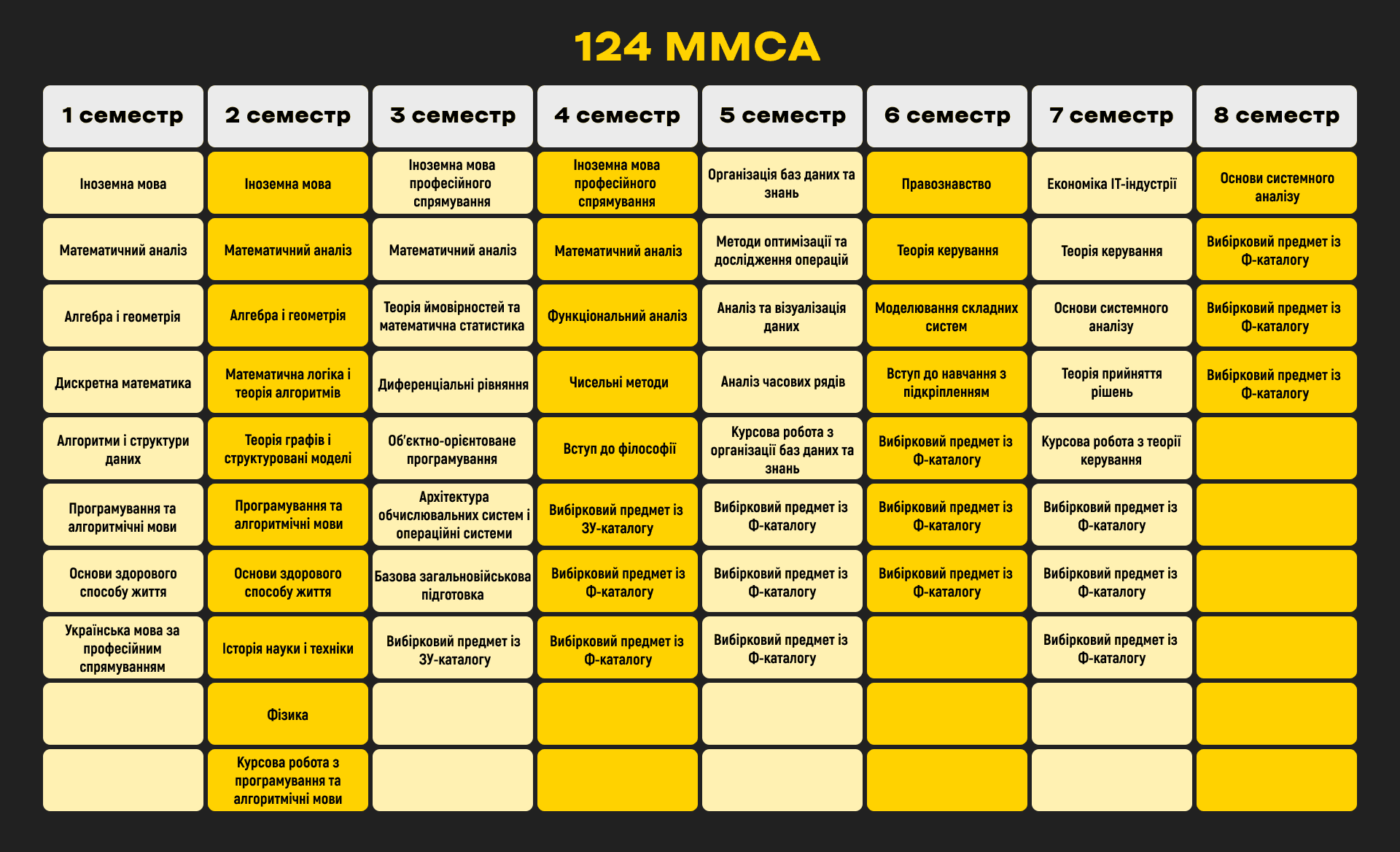
The full list of subjects and the semesters they are taken in is shown below:
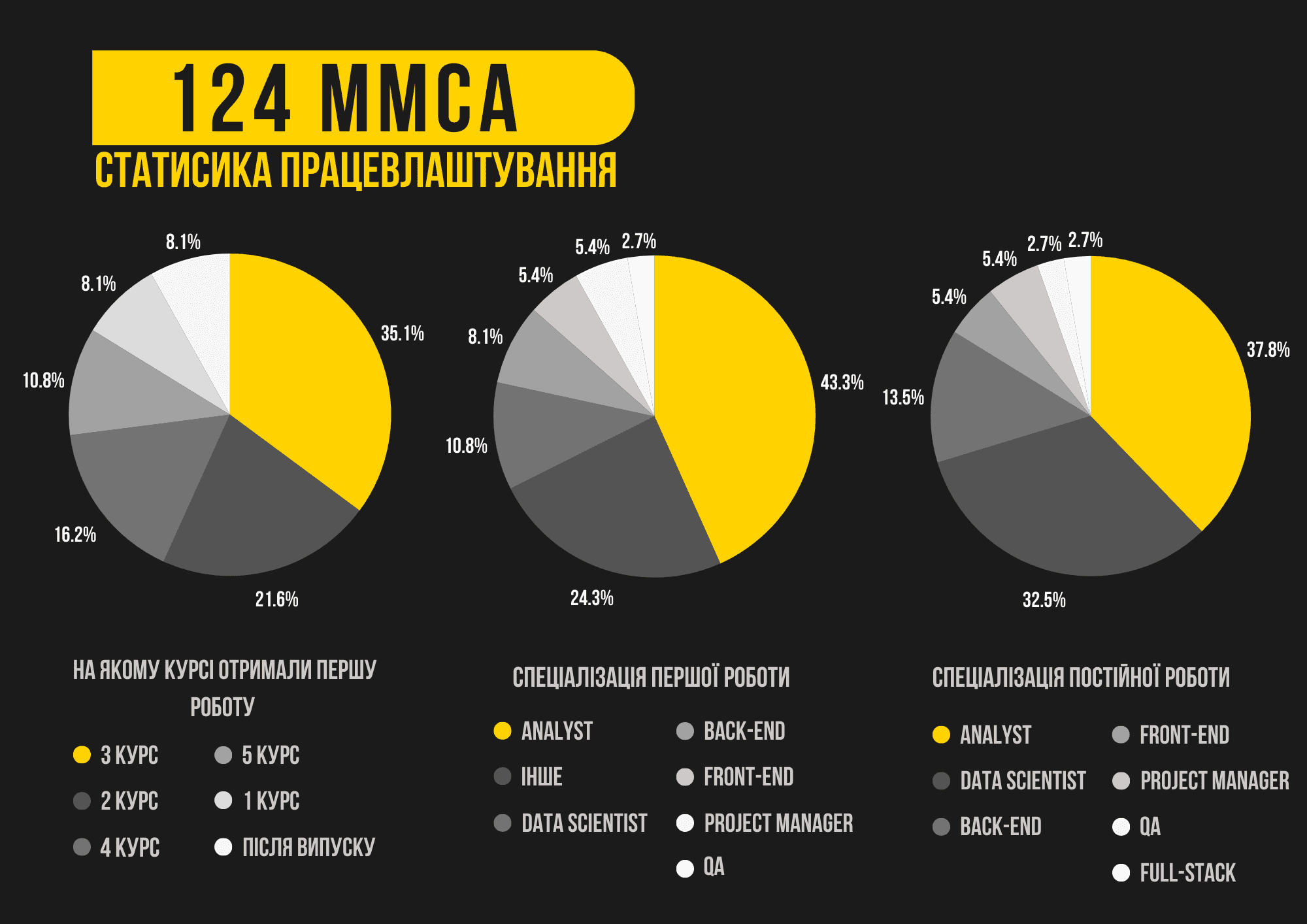
Students of the F4 specialty work across many areas of IT. Most often they start their careers as analysts, doing data analysis and supporting business decisions. Back-end and front-end development are also popular directions, where they are responsible for the technical side of a product and its visual layer. Some students choose Data Science, working with analytics, artificial intelligence and machine learning. Some graduates go into software testing, ensuring quality, or run development processes as a Project Manager. Later on, some move into full-stack developer roles, combining several technical jobs at once.
The “Systems Analysis” specialty suits people who are ready to work intensively with mathematics, who want to develop analytical thinking and master modern programming and machine-learning tools. If you like solving hard problems, modelling processes and delivering optimal solutions — you will find your place here. Students of this specialty become versatile professionals, in demand in IT consulting, financial modelling, data analytics and project management.

Advertising and PR: real work with content and brands from year one.
07.11.2025 · 5 min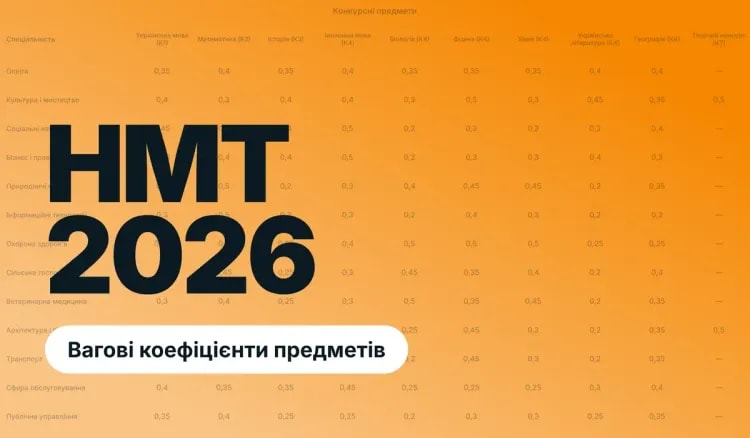
NMT weighting coefficients: which subject moves your score most.
03.08.2026 · 5 min
A promo code for 100 UAH off the Admission Simulation. Valid 30 days.
27.07.2026 · 4 min