

07.06.2026 · 4 min



IT careers, salaries and first-hand accounts from IASA students.
Today’s job market needs specialists who can analyse complex processes, design effective solutions and work with artificial intelligence. One of the institutions that deliberately trains people like that is IASA (the Institute for Applied System Analysis) at Igor Sikorsky Kyiv Polytechnic Institute.
This piece pulls together the real picture: employment statistics for IASA students and graduates, an overview of popular IT specialties with salary benchmarks, a list of companies, useful courses — and first-hand accounts from people who have already walked this path.
Important: all the salary figures below are averaged benchmarks. Actual pay depends on the company, the candidate’s level, what is agreed at the interview and the grade the company has approved.
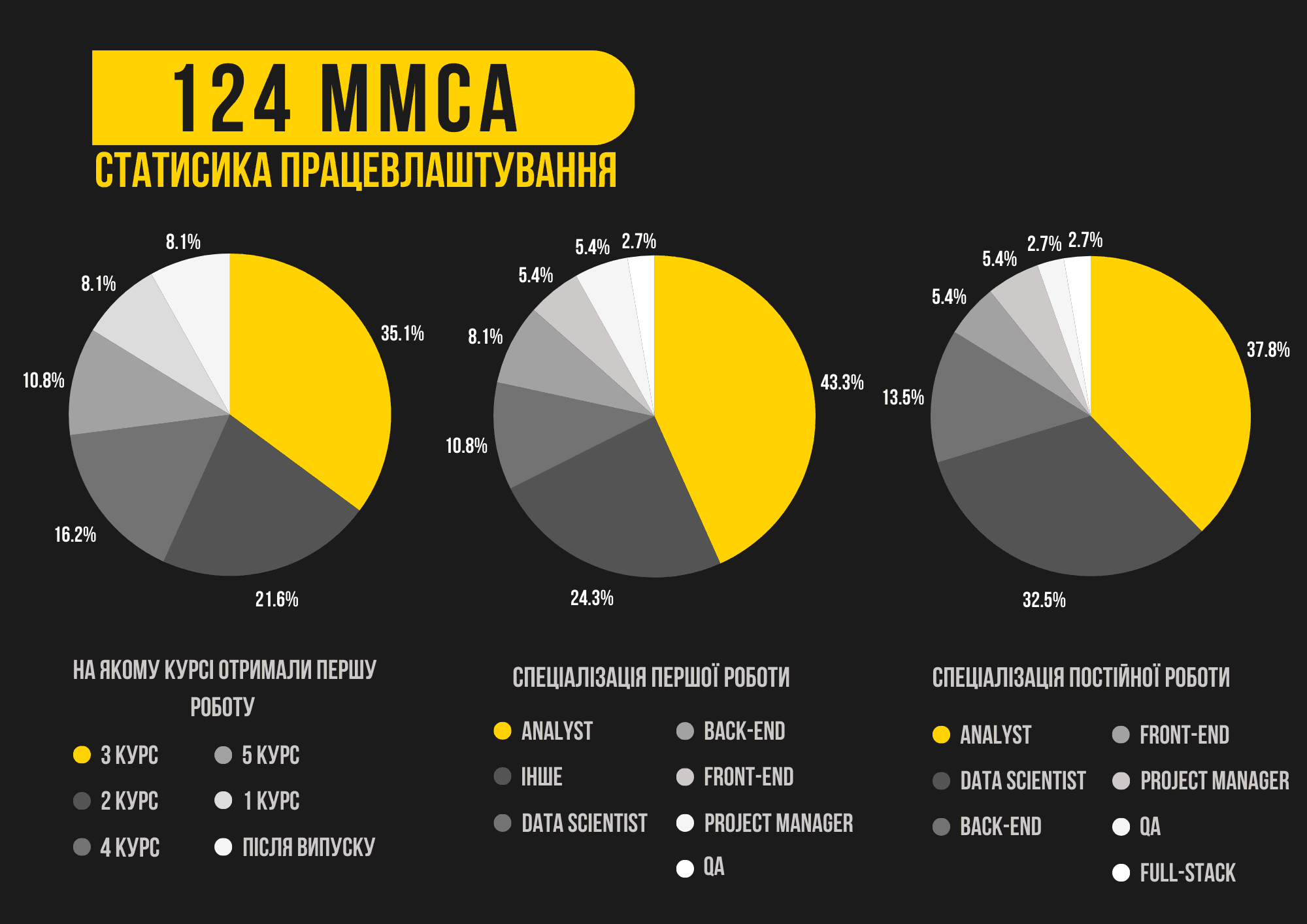
Below are the employment figures for students and graduates of the IASA departments, broken down by specialty.

The numbers speak for themselves: a large share of IASA students start working while still studying, not after they receive their diploma.
IASA trains specialists in three main directions: systems analysis (F4), artificial intelligence (F3 AI) and systems design (F3 SD). Despite the differences in emphasis, all three share a powerful mathematical foundation — and that is exactly what graduates name as the main advantage.
The first two years focus on the fundamentals: mathematical analysis, linear algebra, probability theory, statistics, the basics of programming. The senior years bring specialisation: machine learning, natural language processing, systems design, data analysis.
Beyond technical skills, IASA also builds soft skills — the ability to work in a team, solve non-standard problems and manage your time sensibly. Networking matters just as much: students often find their first employers or business partners among their own coursemates.
Develops machine-learning algorithms, builds and trains models and integrates them into products. Often works with image, text or voice processing, or with recommendation systems. One of the most common trajectories among graduates of the 122 AI direction.
Responsible for the user interface: markup, interactivity, responsiveness. Works closely with designers and connects data through APIs.
Builds the server side of applications: logic, APIs, databases, security. Ensures stable interaction between the front end and the data.
Combines front end and back end — builds an application single-handedly, from the database to the browser interface.
Builds the infrastructure for collecting, processing and storing data. Ensures pipelines are reliable and systems scale. A sought-after role among students of the 124 direction.
Analyses large datasets, builds predictive models, runs A/B tests. Explains the conclusions to a non-technical audience and helps the business make data-driven decisions.
Three related but distinct roles — all popular among students of the analytical directions at IASA.
Data Analyst — reports, dashboards, data-based trends.
Junior: ~2,000 | Senior/Lead: ~$3,000
Product Analyst — user behaviour, A/B tests, feature prioritisation.
Junior: ~2,200 | Senior/Lead: ~$4,200
Business Analyst — gathering requirements, describing business processes, drafting specifications.
Junior: ~2,200 | Senior/Lead: ~$3,700
Programs microcontrollers and hardware components, develops firmware, keeps things stable in resource-constrained environments.
Designs interfaces and makes sure they are easy to use. Runs user research, creates prototypes, tests solutions.
Project Manager (more often in outsourcing) — coordinates development: deadlines, risks, communication, budget.
Junior: ~2,100 | Senior/Lead: ~$3,600
Product Manager — sets the product vision, researches the market, builds the roadmap.
Junior: ~2,900 | Senior/Lead: ~$4,200
Develops game logic, animation, physics and AI. Works with Unity, Unreal Engine and network protocols.
Tests software: writes test cases, runs manual and automated testing, logs and tracks bugs.
Develops software systems — from the architecture through to maintenance. Solves difficult engineering problems.
These are companies where students and graduates of the institute actually work or have interned:
EPAM Systems — one of the largest IT companies in the region, specialising in outsourced development and digital platforms.
SoftServe — IT consulting and digital services; runs courses for trainees and juniors.
Ajax Systems — develops wireless security systems with its own full-cycle manufacturing.
GlobalLogic — software development in healthcare, automotive, telecoms and finance.
MacPaw — a Kyiv IT company known for CleanMyMac, Setapp, Gemini and other products.
Uklon — a Ukrainian ride-hailing service operating in 27 cities.
Zvook — a startup founded in part by IASA graduates; develops acoustic sensors for air-defence systems.
Mantis Analytics — an AI-based platform for detecting disinformation in the media space.
Brainstack — a multi-product IT company working in parental control, wellness and AI.
Sigma Software — ranked among the world’s 100 best IT service companies by IAOP.
A diploma is only a starting point. Practitioners stress that continuous development is a necessity, not an option.
Kaggle — free mini-courses in Python, SQL, pandas, scikit-learn and the basics of AI. A database of datasets and competitions to practise on.
DataCamp — career tracks: Data Analyst, Data Scientist, ML Engineer, Data Engineer.
SoftServe IT Academy — paid courses in QA, DevOps, JS, Python, .NET and Java for trainees and juniors.
Sigma Software University — courses for Junior+ and Middle specialists.
Coursera and Udemy — a wide choice for specialists of any profile.
Entering the market early is one of the most common questions among IASA students. There is no single answer.
Year 1 — most people advise concentrating on the fundamentals. Mathematics and algorithms are what is hard to catch up on later.
Year 2 — if you have the basics and a few projects of your own on GitHub, you can try for an internship. Experience matters more than salary at this stage.
Year 3 — the optimal moment for an active search. This is when most companies recruit interns and juniors.
Year 4 — you should ideally already have experience. Many people stay on at the company in a full position after an internship.
ML Engineer, Mantis Analytics
Studying at IASA had a big effect on my career — not so much through specific knowledge as through the environment and the general approach. It is a place that teaches you to think and to take responsibility for yourself. I went through several positions — from data analyst to data scientist, and each one helped me understand what I want to do. On entering the market early: if you have a clear sense of why, it is valuable. But if the only reason is money or “everyone does it”, it is better to wait.
Product Analytics Lead, TENTENS Tech (a SKELAR partner)
Mathematical analysis, linear algebra, probability theory, statistics — all of it builds literacy and a feel for numbers. But the greatest value is the community: it was through the community that I heard about the Analytics School and got to where I work now. I would not advise entering the market before year 2. After that it depends on your goals: if your path is science or serious mathematics, keep studying at full strength. If it is IT or business — start looking for experience.
PhD Student, Senior Computer Vision Engineer (Better Medicine), Kaggle Competitions Grandmaster, Co-Founder of Zvook
The fundamental mathematical training of the first two years is what gives you the edge on hard problems. The formula is simple: if the job can teach you more, go for it. If it is a galley, keep studying instead. What matters is the knowledge, not just a line on your CV.
The common denominator across all these accounts is that being deliberate matters more than being fast. IASA gives you a strong foundation and an environment to grow in, but everyone’s trajectory stays their own. The main thing is to understand why you are entering the market, and not to stop learning wherever you happen to be doing it.
Our mission is to make choosing an education informed, simple and clear. All the calculators, tests, articles and admission tools are free.
If you support our mission — help us with a donation of any amount.


Advertising and PR: real work with content and brands from year one.
07.11.2025 · 5 min
NMT weighting coefficients: which subject moves your score most.
03.08.2026 · 5 min
A promo code for 100 UAH off the Admission Simulation. Valid 30 days.
27.07.2026 · 4 min